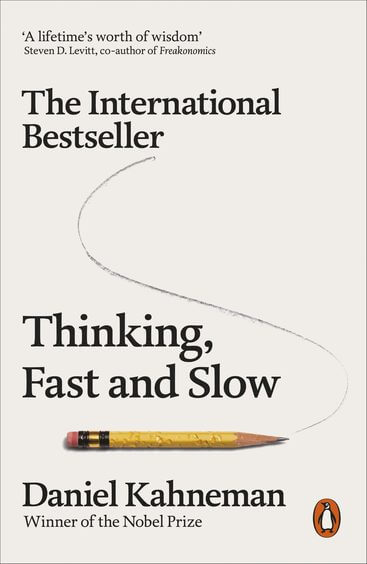
Book Covers


Book Meta
- Title: Thinking, Fast and Slow
- Author(s): Daniel Kahneman
- Length: 512 pages
- ISBN-13: 978-0374533557
- Publisher: Farrar, Straus and Giroux
- Publication Year: 2013
Core Ideas
The main idea of Thinking, Fast and Slow is that the mind operates using two distinct modes. One works quickly and automatically, forming impressions, feelings, and impulses with little effort or awareness. The other is slower and more deliberate, capable of reasoning, calculation, and self-control, but it requires attention and is easily fatigued. Much of everyday life is guided by the first mode, while the second often plays a supporting role rather than acting as a supervisor.
Because the fast mode is efficient, it routinely substitutes difficult questions with easier ones without announcing the switch. When asked to judge probability, it may answer with plausibility; when asked to assess risk, it may respond with familiarity; when asked to evaluate evidence, it may rely on coherence. These substitutions feel natural and convincing, which is why errors often go unnoticed.
Confidence frequently reflects the internal consistency of a story rather than the quality of the evidence behind it. When information fits together smoothly, the mind experiences ease, and ease is commonly mistaken for truth. As a result, people tend to underestimate uncertainty, overlook missing data, and place excessive trust in intuition, especially in complex or unpredictable environments.
Statistical reasoning does not come naturally. The mind prefers specific stories to abstract distributions and treats chance events as meaningful patterns. This leads to systematic misjudgments in areas such as forecasting, risk assessment, and performance evaluation, where random variation is often mistaken for skill or intent.
While the slower mode of thinking can correct these tendencies, it is not always engaged. Attention is limited, effort is costly, and the mind often accepts intuitive answers unless there is a clear reason to intervene. Understanding how these two modes interact does not eliminate error, but it makes it easier to recognize situations where intuition is likely to mislead and where deliberate thinking deserves priority.
Cognitive Impact Map
How This Book Affects Your Thinking
Challenges
-
It questions the assumption that careful thinking reliably overrides intuitive error.
-
It challenges the belief that confidence is a dependable signal of accuracy.
-
It unsettles the idea that experience naturally leads to better judgment.
Reframes
-
It reframes errors in judgment as predictable patterns rather than personal flaws.
-
It shifts decision-making from isolated choices to interactions between mental modes.
-
It recasts rationality as a limited resource, not a default human state.
Strengthens
-
It sharpens the suspicion that intuition often substitutes ease for truth.
-
It reinforces the sense that randomness is routinely mistaken for meaning.
-
It clarifies why statistical reasoning feels unnatural despite its importance.
Book Link
Full Disclosure: If you click the link below and purchase this book on Amazon, we may earn a small commission at no additional cost to you. These commissions help support Unsans and keep it running. Thank you for your support; we genuinely appreciate it.
Link: https://amzn.to/4bePksJ
Thank you!
What You Learn From This Book
Key Takeaways
Good judgment depends less on intelligence than on recognizing when your mind is taking shortcuts without your consent.
Canonicity & Authority
Canonical
Grade: High
-
The book is routinely cited across psychology, behavioral economics, public policy, management, and popular writing on judgment.
-
Many later works treat its concepts as shared reference points rather than ideas needing introduction.
-
Even critical discussions often assume familiarity with its core ideas and vocabulary†.
Influence
Grade: High
-
Its ideas shaped fields well beyond psychology, including economics, finance, medicine, law, UX design, marketing, and risk analysis.
-
Concepts introduced or consolidated in the book are embedded in how organizations talk about decision errors and human judgment‡.
-
The influence is not confined to theory; it altered applied language and practice.
Relevance
Grade: High
-
The book addresses persistent features of human cognition rather than a narrow historical moment.
-
Its core ideas continue to be invoked in discussions of technology, media, finance, and governance years after publication§.
-
Even as specific studies are debated, the broader framing remains durable.
Author Authority
Grade: High
-
Daniel Kahneman is cited outside psychology in economics, public policy, finance, and organizational theory.
-
His work informs how non-psychologists reason about uncertainty, risk, and rationality††.
-
He is referenced not only as a researcher but as a conceptual authority.
Overall Pattern
This is a rare case where a single work scores high across all four axes, not because it is unchallenged, but because it reshaped vocabulary, assumptions, and frameworks across disciplines.
Gist of Readers’ Reviews on Amazon
What readers liked most:
-
Readers often valued how the book gave names and structure to thinking errors they had long sensed but could not articulate.
-
Many described a lasting change in how they evaluate news, risks, financial choices, and their own confidence.
-
Some appreciated the empirical grounding, finding reassurance in the idea that mistakes are systematic rather than personal failures.
What readers liked least:
-
A common complaint was the book’s density, with readers finding it mentally taxing and slow to progress through.
-
Some felt that examples became repetitive, reinforcing points they believed were already clear.
-
A portion of readers expected practical techniques and were disappointed by the book’s diagnostic rather than prescriptive nature.
Page Sponsor’s Message (Why?)
SealedWeb is a zero-trust security platform that lets you share files securely while retaining full control of your information. Learn more: https://www.sealedweb.com/landing-offer?utm_source=unsans.com.
Helpful External Links
Articles
LSE Review of Books
An analytical review from LSE Review of Books situates the book within psychology and economics, explaining Kahneman’s two systems of thought and how they challenge traditional assumptions about rational decision-making, while highlighting its wide influence across fields.
What you’ll get from it:
-
A balanced explanation of System 1 and System 2 thinking.
-
How the book reshapes views on judgment and rationality.
-
Context on why it mattered to economists and psychologists.
Read it at this link: https://blogs.lse.ac.uk/lsereviewofbooks/2012/09/04/book-review-thinking-fast-and-slow-by-daniel-kahneman/.
Thinking, Fast and Slow | Revisited
A Medium piece (“Thinking, Fast and Slow | Revisited”) revisits Kahneman’s work in a modern context, interpreting the core concepts and connecting them to contemporary decision frameworks, especially in areas like strategy and technology.
What you’ll get from it:
-
A reflective, modern lens on the book’s two-systems model.
-
Thoughts on why the ideas remain relevant today.
-
Commentary on intuitive versus deliberative thought.
Read it at this link: https://perry-douglas.medium.com/thinking-fast-and-slow-revisited-0d644822ef34.
APS Observer (Behavioral Science Community Review)
The Association for Psychological Science review highlights the book’s ambitious scope while noting the perennial questions it raises: do biases show up outside the lab, and are smart people truly immune from them?
What you’ll get from it:
-
Academic perspective from behavioral science researchers.
-
Discussion of how experiments translate (or don’t) to real-world behavior.
-
Reader reactions in the comments that capture common responses.
Read it at this link: https://www.psychologicalscience.org/observer/thinking-fast-and-slow.
Meta-Scientific Perspective on Replicability
A meta-science article reviewing the book through the lens of the replication crisis in psychology points out that some early studies cited by Kahneman may not replicate well, and suggests reading parts of the book as subjective interpretation rather than objective summary of evidence.
What you’ll get from it:
-
A critique grounded in the evolution of psychology research.
-
Context on how scientific consensus has evolved since publication.
-
A nuanced view of what the book means versus what it proves.
Read it at this link: https://replicationindex.com/2020/12/30/a-meta-scientific-perspective-on-thinking-fast-and-slow/
Biblical Leadership Blog — Balanced Reader Review
A thoughtful personal review on Biblical Leadership offers an accessible take for general readers, noting that the book challenges assumptions about our rationality and prompts self-reflection even if not all claims are fully accepted.
What you’ll get from it:
-
A clear layperson’s synthesis of key ideas.
-
Notes on how the book encourages self-examination.
-
A caution that not all readers will agree with every argument.
Read it at this link: https://www.biblicalleadership.com/blogs/book-review-thinking-fast-and-slow-by-daniel-kahneman/
An Engineer’s View of “Thinking, Fast and Slow”
This article distils the main ideas of the book.
What it covers:
-
Introduces Kahneman’s dual-system model of thinking.
-
Summarizes several key cognitive biases and heuristics.
-
Applies those ideas to the author’s experiences as a Risk Engineer.
Tone & Purpose:
-
Reflective and personal rather than analytical.
-
Aimed at encouraging readers to read the book itself, not replace it.
Read it at this link: https://www.linkedin.com/pulse/engineers-view-thinking-fast-slow-scott-cresswell/.
Videos
Thinking, Fast and Slow | Daniel Kahneman | Talks at Google
This is one of the most direct sources because it’s Kahneman himself explaining the ideas, not a third-party summary — useful to hear the concepts in his own words.
Summary by Productivity Game
This video focuses on key insights and how to apply the ideas to decision-making — like how to slow down automatic thinking and engage deliberate reasoning.
Summary by The Swedish Investor
A popular book-summary channel covering the main cognitive biases and examples that make these ideas stick.
Footnotes
† Wikipedia: Behavioral economics — https://en.wikipedia.org/wiki/Behavioral_economics
‡ Wikipedia: Cognitive bias — https://en.wikipedia.org/wiki/Cognitive_bias
§ Wikipedia: Heuristics in judgment and decision-making — https://en.wikipedia.org/wiki/Heuristics_in_judgment_and_decision-making
†† Wikipedia: Daniel Kahneman — https://en.wikipedia.org/wiki/Daniel_Kahneman
‡‡ Wikipedia: Prospect theory — https://en.wikipedia.org/wiki/Prospect_theory