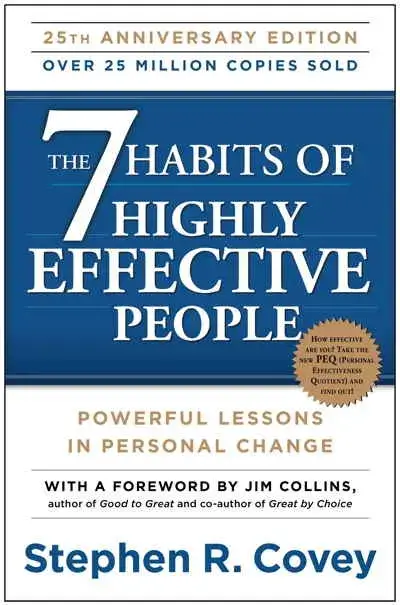
Book Covers


Book Meta
- Title: The 7 Habits of Highly Effective People: 30th Anniversary Edition (The Covey Habits Series), et al.
- Simply Referenced As: The 7 Habits
- Author(s): Stephen R. Covey, et al.
- Length: 464 pages
- ISBN-13: 978-1982137274
- Publisher: Simon & Schuster
- Publication Year: 2020
Core Ideas
At its core, the 7 Habits advances the idea that lasting effectiveness arises from an inward-outward progression: how people see themselves shapes how they act, and how they act shapes their results. The book emphasizes that personal agency, deliberate prioritization, and principled cooperation are not isolated skills but mutually reinforcing ways of being. Its enduring insight is that meaningful change depends less on managing time or others, and more on cultivating character and alignment between values and behavior.
Legacy
Few self-improvement books have so thoroughly embedded themselves into the language of modern work and personal development as the 7 Habits. Its vocabulary—ideas such as personal responsibility, value-centered living, and mutual benefit—has quietly migrated from the page into corporate training programs, leadership workshops, educational curricula, and everyday conversation. The book arrived at a moment when managerial culture was increasingly preoccupied with efficiency and metrics, and it reintroduced a moral and philosophical dimension to effectiveness that many readers felt was missing.
One of the book’s most lasting contributions is its insistence that effectiveness cannot be sustained through tactics alone. In an era increasingly shaped by productivity systems and optimization tools, the 7 Habits reframed success as something grounded in trust, credibility, and long-term relationships. This shift influenced how organizations thought about leadership, encouraging models that emphasized stewardship and shared purpose rather than command-and-control authority—a move aligned with broader discussions about transformational leadership†.
Culturally, the 7 Habits helped normalize the idea that personal development is not merely self-focused but socially consequential. Its emphasis on cooperation and shared outcomes resonated with evolving views on teamwork, negotiation, and institutional trust, intersecting with ideas from organizational psychology‡ and systems thinking§. Even readers who later moved on to newer frameworks often retained its deeper assumptions: that habits compound over time, that priorities reveal values, and that sustainable success is relational rather than purely individual.
Decades after its publication, the book’s influence persists less as a set of remembered chapters and more as a background logic shaping how effectiveness itself is understood. In this sense, the 7 Habits functions not merely as a guide, but as a reference point—a baseline against which newer ideas about productivity, leadership, and personal growth continue to define themselves.
Summary of Book Blurb
The 7 Habits presents a framework for personal and professional effectiveness rooted in character rather than technique. Instead of offering quick fixes or surface-level strategies, the book invites readers to examine the deeper principles that shape how they act, decide, and relate to others. Through a sequence of habits that build progressively—from self-mastery to collaboration and renewal—the book outlines a way of aligning daily behavior with long-term values. The 7 Habits positions effectiveness not as a matter of personality or talent, but as a learnable approach grounded in responsibility, integrity, and sustained growth.
Cognitive Impact Map
How This Book Affects Your Thinking
Challenges
- Effectiveness is often assumed to be a function of talent, intelligence, or personality rather than practiced behavior.
- Personal success is commonly treated as separable from ethical considerations and character.
- Time management is frequently framed as a scheduling problem rather than a prioritization problem.
- Collaboration is often viewed as a compromise between competing interests rather than a source of expanded outcomes.
Reframes
- Effectiveness is reframed as an outcome of internal alignment before external action.
- Control is reinterpreted as responsibility for one’s responses rather than dominance over circumstances.
- Productivity is repositioned around importance and values, not urgency or activity levels.
- Cooperation is reframed as a creative process capable of producing outcomes unavailable to individuals acting alone.
Strengthens
- The intuition that small, repeated behaviors shape long-term identity and results.
- The sense that trust functions as a form of social capital with measurable effects.
- The belief that clarity about values simplifies complex decisions.
- The suspicion that sustainable success depends on renewal and reflection, not constant exertion.
Book Link
Full Disclosure: If you click the link below and purchase this book on Amazon, we may earn a small commission at no additional cost to you. These commissions help support Unsans and keep it running. Thank you for your support; we genuinely appreciate it.
Link: https://amzn.to/4c6EMvW
Thank you!
What You Learn From This Book
Key Takeaways
The 7 Habits leaves readers with the sense that effectiveness is not something to be chased through constant adjustment, but something that emerges when daily actions are consistently aligned with chosen principles and priorities. It encourages seeing life less as a series of isolated tasks and more as a pattern shaped by habits that quietly accumulate over time.
In essence: Lasting effectiveness grows from character-driven choices repeated long enough to reshape both outcomes and identity.
Canonicity & Authority
Canonical
Grade: High
- The 7 Habits is routinely cited as a foundational text in leadership and personal effectiveness literature.
- Its concepts are embedded in corporate training, education systems, and institutional leadership programs worldwide.
- The book functions as a reference point against which later productivity and leadership works are often implicitly compared.
Influence
Grade: High
- The book’s ideas have shaped discourse across management, education, organizational culture, and personal development.
- Its language and frameworks are used by practitioners who may not consciously reference the book itself.
- The influence extends beyond individuals to institutions, curricula, and leadership models
Relevance
Grade: High
- The book addresses durable human concerns—agency, priorities, trust, and cooperation—rather than transient tools or tactics.
- Its principles remain applicable despite changes in technology, work structures, and social norms.
- The book continues to be reread and recommended decades after its initial publication.
Author Authority
Grade: High
- Stephen R. Covey is cited beyond self-help contexts, particularly in leadership, organizational behavior, and ethics.
- His frameworks are referenced in professional and institutional settings rather than limited to popular audiences.
- Covey’s authority rests on conceptual coherence and longevity rather than novelty or trend alignment.
Overall Pattern
The 7 Habits exhibits sustained authority through long-term relevance, deep institutional adoption, and cross-domain influence, marking it as a modern canonical work in applied thought rather than a period-bound productivity manual.
Gist of Readers’ Reviews on Amazon
What readers liked most:
- Many readers report a lasting shift in how they think about responsibility, priorities, and personal agency.
- The habit-based structure is frequently praised for providing a coherent, memorable framework rather than isolated tips.
- Readers often describe the book as useful across life domains — work, family, leadership, and self-reflection.
What readers liked least:
- Some readers find the pace deliberate and the explanations repetitive.
- A portion of readers feel the examples reflect a corporate or managerial worldview that may not resonate universally.
- Others note that the ideas require sustained effort and reflection, offering fewer immediate or tactical shortcuts.
Page Sponsor’s Message (Why?)
SealedWeb is a zero-trust security platform that lets you share files securely while retaining full control of your information. Learn more: https://www.sealedweb.com/landing-offer?utm_source=unsans.com.
Helpful External Links
Articles
Transformational Leadership
An overview of leadership models that emphasize values, vision, and moral influence.
What you’ll get from it:
- Context for the leadership philosophy underlying the 7 Habits
- A broader academic framing of value-centered leadership
- Insight into why trust and vision matter in organizations
Read it at this link: https://en.wikipedia.org/wiki/Transformational_leadership
Locus of Control
A psychological concept describing how people perceive responsibility for outcomes.
What you’ll get from it:
- Deeper grounding for the book’s emphasis on responsibility
- A psychological lens on agency and behavior
- Language to distinguish internal vs. external attribution
Read it at this link: https://en.wikipedia.org/wiki/Locus_of_control
Systems Thinking
An introduction to viewing problems as interconnected systems rather than isolated events.
What you’ll get from it:
- A framework that complements the book’s long-term perspective
- Better understanding of unintended consequences
- Tools for seeing compounding effects over time
Read it at this link: https://en.wikipedia.org/wiki/Systems_thinking
Videos
Stephen R. Covey on the 7 Habits (FranklinCovey)
A lecture-style overview by the author expanding on the book’s core philosophy.
What you’ll get from it:
- Direct articulation of the book’s underlying assumptions
- Clarification of how the habits fit together
- Historical context from the author himself
The Power of Habit (Charles Duhigg – Talk)
A complementary perspective on habit formation from behavioral science.
What you’ll get from it:
- A scientific angle on habit loops
- Contrast between character-based and behavior-based models
- Practical insight into habit change
Footnotes & Further Reading
† Transformational leadership — https://en.wikipedia.org/wiki/Transformational_leadership
‡ Organizational psychology — https://en.wikipedia.org/wiki/Industrial_and_organizational_psychology
§ Systems thinking — https://en.wikipedia.org/wiki/Systems_thinking