Book Covers


Book Meta
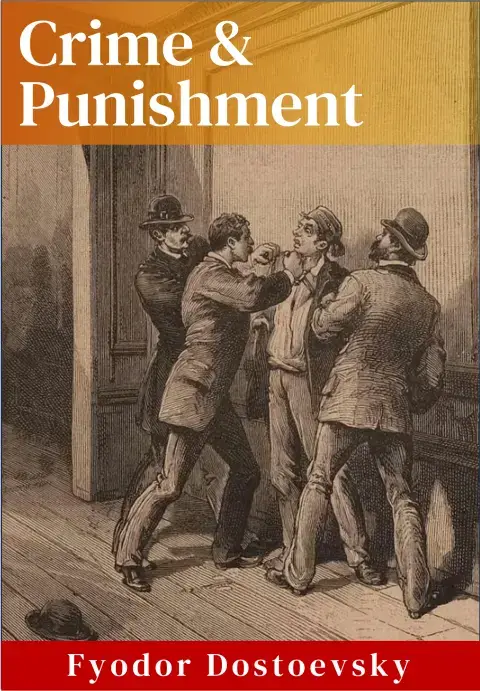
- Title: Crime and Punishment: Deluxe Hardbound Edition
- Simply Referenced As: C&P
- Author(s): Fyodor Dostoevsky
- Length: 568 pages
- ISBN-13: 978-9354403798
- Publisher: Fingerprint! Publishing
- Publication Year: 2022
Core Ideas
C&P explores how moral reasoning collapses when abstract ideas are used to override lived human consequences. The book suggests that conscience is not silenced by intellectual certainty, only postponed, and that attempts to rank human lives through theory invite psychological fracture rather than clarity. Long after the specifics fade, what remains is the insight that inner accountability operates independently of external punishment, and that self-exemption corrodes the very faculties it claims to elevate.
Legacy
Few novels have entered public consciousness as deeply as C&P, largely because the book gave language to a tension modern societies continue to struggle with: the clash between moral universals and individual rationalization. Long before psychology formalized concepts like cognitive dissonance†, Dostoevsky dramatized the mind’s capacity to defend its own transgressions while quietly deteriorating under their weight.
The book reshaped how literature engages with morality—not as a set of rules imposed from outside, but as an internal force that resists suppression. In doing so, C&P shifted the novel from a vehicle of social realism into a laboratory of consciousness. Later existential thinkers, including those associated with existentialism‡, found in the book a template for examining freedom, responsibility, and self-deception without moral simplification.
Beyond philosophy, C&P influenced how societies think about crime itself. The book challenged the notion that wrongdoing can be fully understood through legal categories alone, foregrounding instead the psychological and social pressures that precede action. Modern criminology, ethics, and even legal theory continue to echo this shift toward interiority and motive§.
Culturally, C&P persists because it resists resolution. It neither flatters intellect nor condemns curiosity; instead, it exposes how easily reasoning becomes a refuge from empathy. In an age increasingly shaped by ideological certainty, the book’s refusal to grant moral shortcuts keeps it unsettlingly current.
Summary of Book Blurb
Set in the tense, airless streets of 19th-century St. Petersburg, C&P follows a young former student who tests an idea before he tests the law: whether an intelligent person may step outside moral limits in service of a greater good. As the consequences of that experiment begin to close in, the book traces the psychological unraveling that follows—not through action alone, but through thought, hesitation, guilt, and self-justification. What unfolds is less a tale of crime than an inquiry into conscience, responsibility, and the invisible pressures that shape human judgment.
Cognitive Impact Map
How This Book Affects Your Thinking
Challenges
- C&P unsettles the assumption that intelligence naturally produces moral clarity.
- It challenges the belief that wrongdoing can be compartmentalized without psychological residue.
- It questions the idea that noble intentions neutralize harmful actions.
- C&P destabilizes the belief that guilt is primarily a social or legal construct.
Reframes
- C&P reframes crime as a psychological process rather than a discrete event.
- C&P recasts moral failure as a gradual erosion driven by self-justification.
- The book shifts punishment from an external outcome to an internal condition.
- It reinterprets freedom as inseparable from responsibility, not opposed to it.
Strengthens
- C&P reinforces the intuition that conscience operates independently of ideology.
- The book sharpens the sense that abstract reasoning can distance individuals from human reality.
- C&P deepens the suspicion that moral shortcuts exact hidden cognitive costs.
- It clarifies the link between isolation and distorted self-assessment.
Book Link
Full Disclosure: If you click the link below and purchase this book on Amazon, we may earn a small commission at no additional cost to you. These commissions help support Unsans and keep it running. Thank you for your support; we genuinely appreciate it.
Link: https://amzn.to/4rxNacz
Thank you!
What You Learn From This Book
Key Takeaways
C&P leaves the reader with a durable insight: when people grant themselves theoretical permission to bypass ordinary moral limits, the cost is rarely paid in public consequence alone but in the quiet disintegration of inner coherence. The book lingers not because of what happens, but because it traces how justification slowly replaces judgment, and how certainty can become a form of blindness.
In essence: moral reasoning detached from empathy narrows rather than expands human freedom.
Canonicity & Authority
Canonical
Grade: High
- The book is routinely cited in literary, philosophical, and psychological discourse.
- C&P is a staple of academic curricula across cultures and languages.
- Its themes recur in discussions of morality, crime, and responsibility.
Influence
Grade: High
- C&P shaped existential philosophy and psychological realism in fiction.
- The book influenced thinkers beyond literature, including ethicists and social theorists.
- Its ideas continue to surface in debates about justice and moral agency.
Relevance
Grade: High
- The questions raised by C&P persist across political and cultural eras.
- Its focus on rationalization mirrors contemporary ideological conflicts.
- The book remains applicable without reliance on historical context.
Author Authority
Grade: High
- Dostoevsky is cited in philosophy, theology, psychology, and cultural criticism.
- His work informs discussions well beyond Russian literature.
- C&P is often referenced as representative of his broader moral inquiry.
Overall Pattern
C&P demonstrates enduring authority through sustained cross-disciplinary relevance and deep cultural embedding.
Gist of Readers’ Reviews on Amazon
What readers liked most:
- Readers frequently cite the psychological depth and realism of inner conflict.
- Many describe a lingering emotional and intellectual impact after finishing the book.
- Readers appreciate how C&P provokes reflection rather than offering clear answers.
What readers liked least:
- Some readers find the pacing demanding and mentally intense.
- Others note difficulty engaging with the dense interior monologues.
- A portion of readers struggle with the emotional heaviness of the subject matter.
Page Sponsor’s Message (Why?)
SealedWeb is a zero-trust security platform that lets you share files securely while retaining full control of your information. Learn more: https://www.sealedweb.com/landing-offer?utm_source=unsans.com.
Essays, Reflections, Cultural Readings
Articles
Crime and Punishment (Wikipedia)†
A comprehensive overview of the book’s themes, historical context, and reception.
Why it matters:
- Context for Dostoevsky’s intellectual environment
- Thematic framing without plot dependence
- Entry points to related philosophical discussions
Article link: https://en.wikipedia.org/wiki/Crime_and_Punishment
Existentialism (Stanford Encyclopedia of Philosophy)‡
A scholarly account of existentialist thought that resonates with C&P’s concerns.
Why it matters:
- Conceptual grounding for freedom and responsibility
- Philosophical language for ideas implicit in the book
- Broader intellectual lineage
Article link: https://plato.stanford.edu/entries/existentialism/
Psychology of Guilt (APA Dictionary Overview)§
An accessible discussion of guilt as a psychological phenomenon.
Why it matters:
- Modern framing of internal punishment
- Vocabulary to articulate moral emotions
- Bridges between literature and psychology
Article link: https://dictionary.apa.org/guilt
Videos
“Crime and Punishment – A Psychological Reading” (Academic Lecture)††
A university-level analysis focusing on moral psychology.
Why this matters:
- Structured interpretation
- Conceptual clarity
- Connections to modern psychology
“Existentialism Explained” (CrashCourse Philosophy)‡‡
An engaging overview of existentialist ideas.
Why this matters:
- Conceptual scaffolding
- Clear terminology
- Context for post-Dostoevskian thought
Footnotes & Further Reading
† https://en.wikipedia.org/wiki/Crime_and_Punishment
‡ https://plato.stanford.edu/entries/existentialism/
§ https://dictionary.apa.org/guilt
¶ https://www.bbc.com/reel/video/p07r6j1g/why-dostoevsky-still-matters
†† https://www.youtube.com/watch?v=Vtkv3-endYc
‡‡ https://www.youtube.com/watch?v=YaDvRdLMkHs