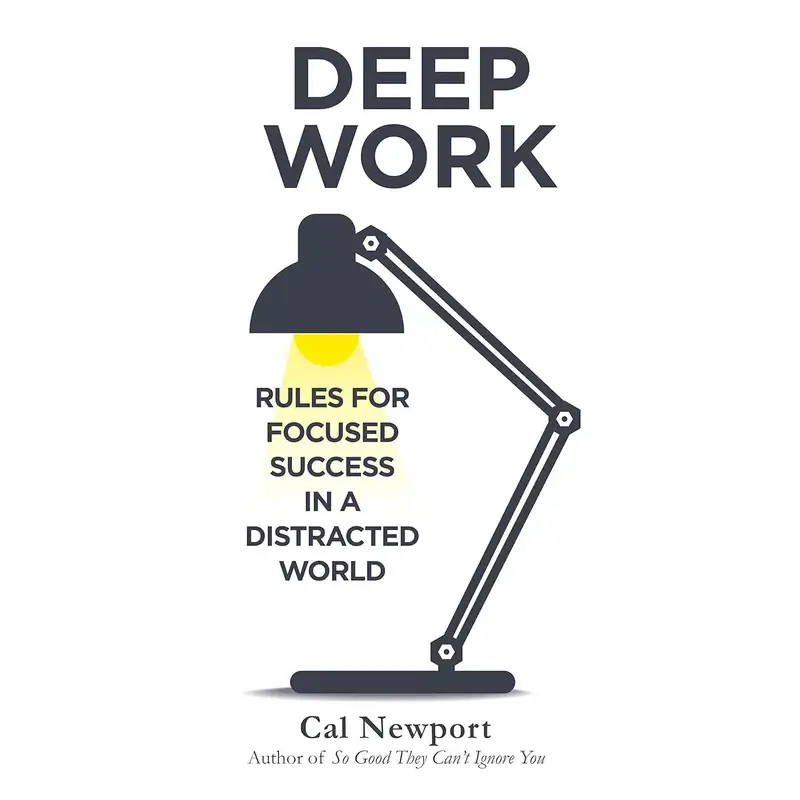
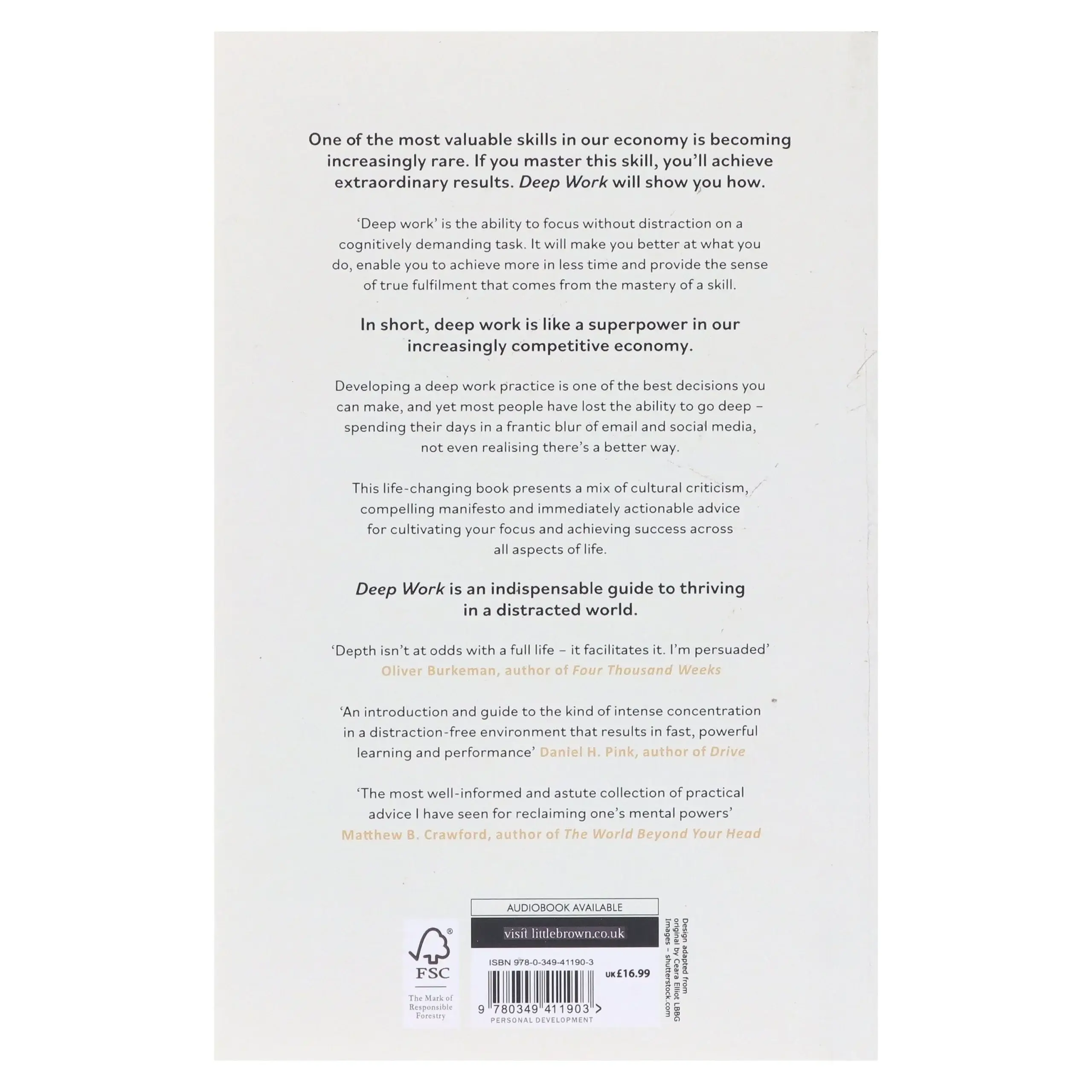
Book Covers
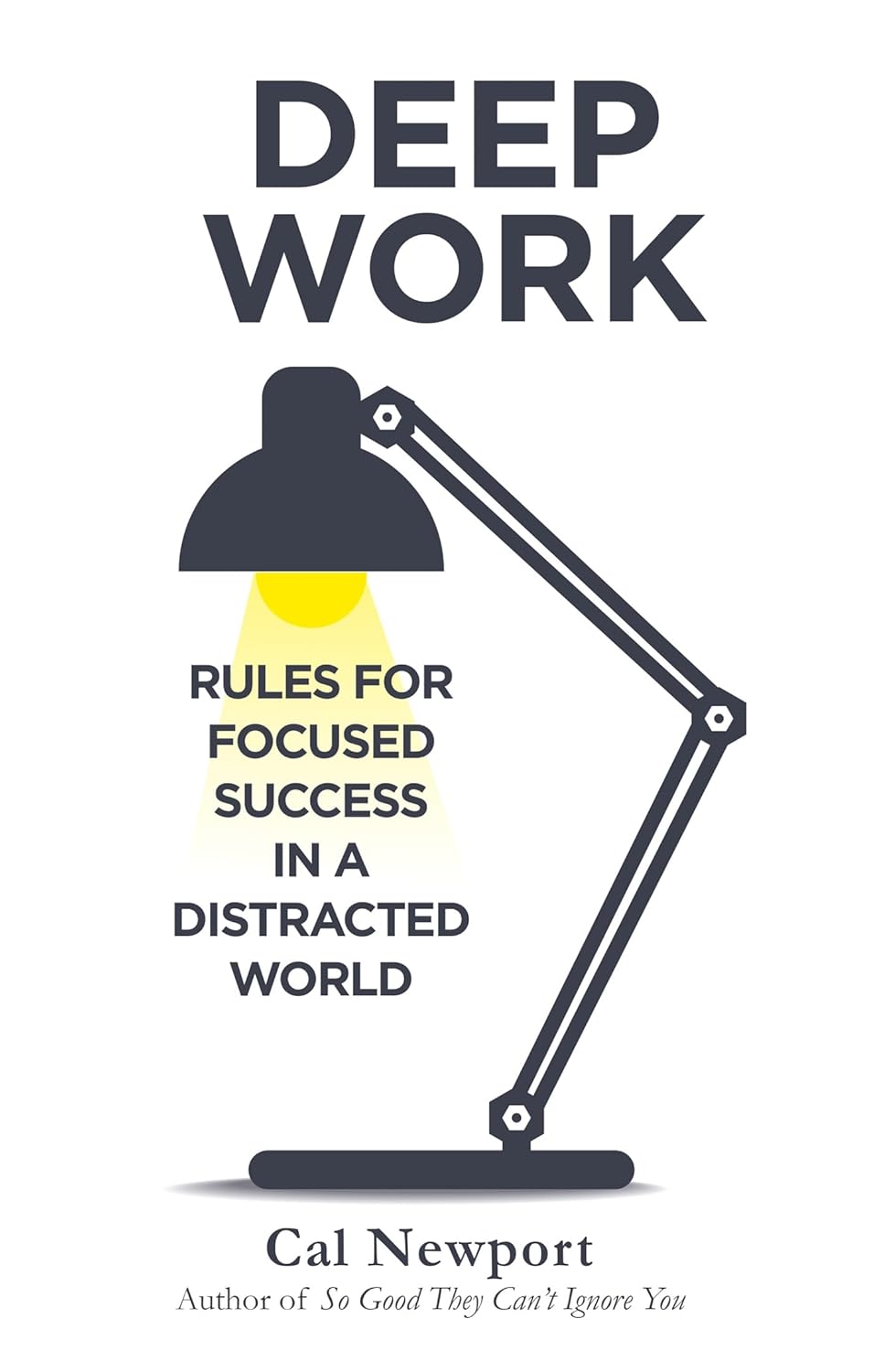
Book Meta
- Title: Deep Work: Rules for Focused Success in a Distracted World
- Author(s): Cal Newport
- Length: 304 pages
- ISBN-13: 978-0349413686
- Publisher: Little Brown
- Publication Year: 2013
Core Ideas
The way most knowledge workers spend their days is dominated by interruptions, shallow tasks, and constant switching of attention; this exhausts your cognitive energy and trains your brain to crave distraction. In contrast, deep work — defined as professional activity performed in a state of distraction-free concentration that pushes your cognitive limits — enhances learning and performance and produces rare value. To cultivate it, you must treat attention as a finite resource: protect it with rituals, minimize interruptions, and deliberately schedule uninterrupted focus time, because mastering hard things quickly and producing exceptional results both depend on your ability to think deeply rather than react incessantly to shallow demands.
Book Blurb
Deep Work argues that the ability to focus without distraction on cognitively demanding tasks is increasingly rare and valuable in an economy driven by knowledge work, and those who cultivate this skill will thrive§. Newport defines deep work as the concentrated engagement with challenging intellectual tasks and contrasts it with shallow work — low-value, easily replicable tasks such as responding to emails or attending trivial meetings. He explains why modern digital tools and constant interruptions fragment attention and diminish the quality of professional output. Through research, historical examples, and practical frameworks, Newport presents four rules for cultivating deep work: (1) create rituals and boundaries that support sustained concentration, (2) embrace periods of boredom to strengthen attentional control, (3) be intentional about tool use, including quitting social media that doesn’t serve your goals, and (4) minimize shallow work through scheduling, batching, and disciplined time management. The book blends cultural critique with actionable strategies for reclaiming focus and achieving meaningful productivity in a world full of digital noise.
Cognitive Impact Map
How This Book Affects Your Thinking
Challenges
- Deep Work challenges the assumption that multitasking is an effective way to manage knowledge work, implicitly questioning how human attention actually functions under cognitive load†.
- It calls into question the belief that constant digital availability is synonymous with professional value, pushing against norms shaped by the attention economy‡.
- It disputes the belief that visible busyness reliably signals productivity, or rapid responsiveness is inherently valuable, especially in environments dominated by shallow coordination work.
Reframes
- It reframes productivity as the capacity to sustain deep cognitive effort, rather than the volume of tasks completed, shifting emphasis from activity to output quality.
- It interprets distraction not as a personal failure but as an environmental force shaped by incentives, tools, and workplace norms§.
- It changes the question from “How do I manage my time better?” to “What kinds of cognitive states does my work environment make possible?
Strengthens
- It reinforces the intuition that meaningful progress comes from prolonged engagement with difficult problems, a hallmark of creative and intellectual labor¶.
- It clarifies the sense that fragmented attention produces psychological fatigue disproportionate to the apparent effort involved.
- It reinforces the suspicion that many modern work practices persist because they are easy to measure, not because they create lasting value.
Book Link
Full Disclosure: If you click the link below and purchase this book on Amazon, we may earn a small commission at no additional cost to you. These commissions help support Unsans and keep it running. Thank you for your support; we genuinely appreciate it.
Link: https://amzn.to/462ovo4
Thank you!
What You Learn From This Book
Key Takeaways
Mastering the ability to focus deeply — and protecting that focus against distraction — is one of the most impactful skills you can cultivate for meaningful, high-value work.
Canonicity & Authority
Canonical
Grade: High
- Frequently cited in productivity, knowledge-work, and focus discourse.
- Common reference point in discussions of modern work practices.
- Persistently mentioned alongside other defining productivity books
Influence
Grade: High
- Influences business, education, software, and creative communities.
- Referenced in debates on digital distraction and attention economics.
- Shapes organizational norms around meetings, email, and deep focus
Relevance
Grade: High
- Addresses structural features of modern work, not transient tools.
- Remains applicable as long as attention competes with digital systems.
- Continues to resurface during shifts toward remote and knowledge work.
Author Authority
Grade: Average
- Strong authority within productivity and academic commentary.
- Occasionally referenced in broader cultural and media discussions.
- Less cited in formal psychology or neuroscience literature.
Overall Pattern
- The book functions as a modern reference work rather than a classical foundational text.
- Its authority arises from practical coherence and cultural fit, not from formal theory.
- Influence spreads horizontally across professions rather than vertically within academia.
- Relevance is sustained by structural conditions of modern work, not novelty.
- The author’s credibility is contextual and applied, not disciplinary or technical.
- The book’s standing depends more on continued resonance than on institutional endorsement
Gist of Readers’ Reviews on Amazon
What readers liked most:
- Many praise practical tactics for reducing distraction and increasing focused productivity.
- Readers often say the ideas changed how they structure work time.
- The book’s core message — focus is rare and valuable — resonates strongly with professionals and students
What readers liked least:
- Some find the book repetitive, especially in later chapters.
- Critics say advice can feel rigid or unrealistic for people without flexible schedules.
- A few felt the tone and examples assumed a level of privilege.
Page Sponsor’s Message (Why?)
SealedWeb is a zero-trust security platform that lets you share files securely while retaining full control of your information. Learn more: https://www.sealedweb.com/landing-offer?utm_source=unsans.com.
Helpful External Links
Articles
Benefits
- They contextualize Deep Work within modern work culture, clarifying how sustained attention has become scarce as digital environments increasingly monetize distraction‡.
- They surface critiques and limitations, helping readers calibrate expectations rather than treat productivity frameworks as universally applicable.
- They translate the book’s ideas into plain language, making abstract discussions about attention and value creation more concrete and usable.
Stop Wasting Your Days—Discover the Ruthless Power of Deep Work
This article frames Deep Work as a manifesto against modern distraction, emphasizing focus as both a practical and philosophical tool for a meaningful life, not just a way to get more done; it highlights the book’s scientific grounding and actionable rules while also noting limits in applicability outside knowledge-worker contexts.
What you’ll get from it:
- Helps the reader see Deep Work as a cultural response, not just a productivity hack.
- Sharpens awareness of how distraction shapes identity and self-worth, not only output.
- Surfaces practical limits of the book, preventing over-idealization of its prescription.
Read it at this link: https://www.probinism.com/deep-work-book-review-critical-analysis/
Deep Work (Bestseller Reviews)
This review outlines the book’s core distinction between deep and shallow work, explains why deep focus is becoming both rare and valuable, and summarizes the four practical rules Newport offers for cultivating focus, pointing out that disciplined routines and digital minimalism are central to improving productivity.
What you’ll get from it:
- Provides a clean structural overview that orients first-time readers quickly.
- Clarifies the deep vs. shallow work distinction in operational terms.
- Acts as a reliable refresher for readers who want recall without rereading.
Read it at this link: https://www.bestsellerreviews.org/2025/06/01/deep-work/
Deep Work: Review and Background (Shortform)
This analysis describes the book as a guide to overhauling how you structure your life for sustained attention, while also noting that critics see Newport’s examples as privileging those with flexible schedules and that later chapters can feel repetitive as rules get more detailed.
What you’ll get from it:
- Helps readers situate the book within Newport’s broader intellectual project.
- Highlights recurring critiques, enabling a more balanced interpretation.
- Breaks the book into actionable components without flattening nuance
Read it at this link: https://www.shortform.com/blog/deep-work-review/
Videos
Benefits
- They compress the book’s central distinctions into visual narratives, aligning with how dual-channel learning improves retention and recall‡.
- They reinforce key concepts through repetition and contrast, which strengthens memory consolidation without requiring rereading.
- They offer a low-commitment entry point for testing whether the book’s worldview resonates with one’s own work constraints and habits.
Deep Work Summary & Review (Cal Newport) – ANIMATED
Animated summaries of Deep Work distill key concepts — defining deep vs. shallow tasks, explaining why deep focus is valuable, and outlining strategies for achieving uninterrupted concentration — though exact visuals vary per channel, the core message centers on cultivating deep focus for better outcomes.
Deep Work by Cal Newport: Animated Review and Summary
This animated video explains Deep Work as the ability to work with sustained concentration free of distraction to significantly boost productivity and quality of output, while contrasting it with shallow work and reinforcing the central idea that focus is a rare “superpower” worth training.
Footnotes
§ Knowledge work — https://en.wikipedia.org/wiki/Knowledge_worker
† Attention — https://en.wikipedia.org/wiki/Attention
‡ Attention economy — https://en.wikipedia.org/wiki/Attention_economy
‡ Dual-coding theory — https://en.wikipedia.org/wiki/Dual-coding_theory
§ Incentive structures — https://en.wikipedia.org/wiki/Incentive
¶ Knowledge work — https://en.wikipedia.org/wiki/Knowledge_worker