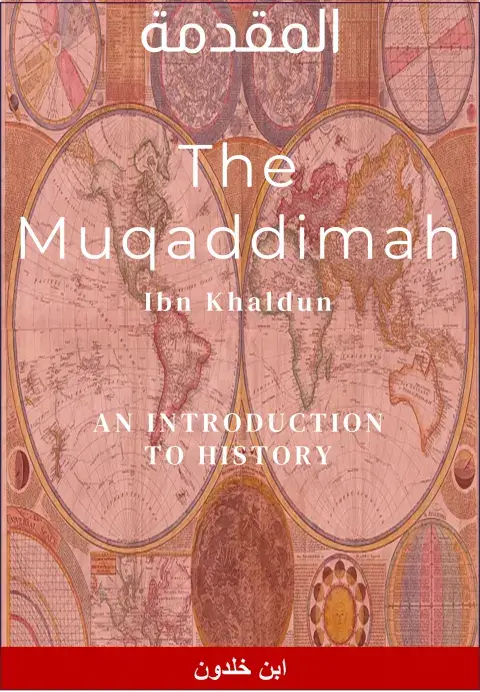
Book Covers

Book Meta
- Title: The Muqaddimah: An Introduction to History – Abridged Edition
- Simply Referenced As: The Muqaddimah
- Author(s): Ibn Khaldûn
- Length: 512 pages
- ISBN-13: 978-0691166285
- Publisher: Princeton University Press
- Publication Year: 2015
Core Insight
Ibn Khaldûn is often described as a precursor to sociology, economics, and historiography—not because he anticipated their terminology, but because he asked the same kind of questions centuries earlier. His insistence that historical claims be evaluated against known social dynamics introduced a standard of plausibility that still governs serious historical work.
Concepts developed in The Muqaddimah—especially group solidarity and cyclical political change—continue to surface in modern discussions of nationalism, state legitimacy, institutional decay, and empire†. The book’s influence is not confined to the Islamic intellectual tradition; it has been read, cited, and reinterpreted across cultures precisely because it resists parochial explanations.
What endures is not a doctrine, but a method: study society as it behaves, not as it narrates itself.
The Muqaddimah advances the enduring idea that societies are shaped less by individual intentions than by collective forces—social cohesion, economic necessity, and institutional habits—that unfold over time. The book treats history as a patterned process rather than a sequence of accidents, suggesting that rise and decline follow intelligible rhythms. It leaves readers with a durable insight: understanding the present requires attention to long-term social dynamics, not just surface events or heroic narratives.
The central insight of The Muqaddimah is that civilizations follow patterns not because humans intend them to, but because collective life generates constraints and incentives that shape behavior over generations. Power consolidates, prosperity softens discipline, institutions grow complex, and the very success of a social order alters the conditions that once sustained it.
History, in this view, is neither random nor morally scripted — it is patterned, contingent, and shaped by human limits.
Intellectual Impact
What this book quietly does to your thinking.
The Muqaddimah dissolves the illusion that societies are steered primarily by wisdom, virtue, or individual brilliance. It replaces that illusion with a steadier lens: societies behave according to pressures they generate themselves—economic demands, group loyalties, institutional habits, and time.
After reading the book, power looks less personal. Decline looks less sudden. Prosperity looks less innocent.
You begin to notice how success reshapes incentives, how cohesion erodes without being attacked, and how stability often masks slow transformation. Events start to feel less explanatory than the conditions that made them possible.
The book does not leave the reader cynical. It leaves the reader structurally aware —less surprised by repetition, less tempted by simple causes, and more attuned to long arcs.
Compressed takeaway: Civilizations don’t fall because they forget lessons; they fall because their conditions change.
Intellectual Impact Card
How This Book Changes How You See the World
The Muqaddimah alters perception quietly rather than forcefully. After reading it, social life no longer appears as a sequence of intentions, decisions, or moral failures. It begins to look like a layered system shaped by constraints that persist across generations.
Power ceases to feel personal. It appears as a function of cohesion, necessity, and scale. Prosperity no longer seems purely beneficial; it reveals itself as a condition that gradually alters discipline, incentives, and institutional resilience. Decline, in turn, stops looking sudden. It appears slow, cumulative, and often inseparable from earlier success.
The book trains the reader to distrust surface explanations—especially narratives that attribute historical outcomes to virtue, corruption, brilliance, or betrayal alone. It sharpens sensitivity to time: how advantages compound, how habits harden, and how structures outlive the intentions that created them.
What remains after the arguments fade is a durable shift in orientation. One begins to look past events toward the conditions that make them repeatable. History becomes less dramatic, but more intelligible.
Compressed takeaway: Societies change not because they forget lessons, but because the conditions that once sustained them no longer exist.
Legacy & Reach
The legacy of The Muqaddimah lies in its quiet but radical repositioning of history as an analytical discipline rather than a literary or moral one. Centuries before the formal emergence of sociology, economics, or historiography as modern fields, Ibn Khaldûn articulated a framework for studying societies as systems governed by internal logics. His insistence that historical reports be evaluated for plausibility—based on what is known about human behavior, material conditions, and social organization—introduced a standard of critical scrutiny that remains foundational to historical thinking today.
One of the book’s most enduring contributions is its treatment of social cohesion as a decisive force in political life. By emphasizing group solidarity as something that can be cultivated, exhausted, and eventually replaced, The Muqaddimah offered a way to think about power that did not rely solely on legitimacy, religion, or brute force. This lens has proven remarkably adaptable, finding echoes in later discussions of state formation, nationalism, and institutional decay†.
The book’s influence also extends across cultures and centuries because it resists narrow contextualization. Although grounded in the medieval Islamic world, its arguments about labor, taxation, urbanization, and governance translate readily into other historical settings. Modern scholars have drawn parallels between Ibn Khaldûn’s cyclical view of dynasties and later theories of social change, including those found in political economy and historical sociology‡.
Perhaps most striking is how The Muqaddimah reshaped the intellectual posture of the historian. It modeled a stance of epistemic humility—an awareness that narratives are shaped by bias, distance, and interest—while still affirming that disciplined reasoning can yield insight. In this way, the book helped normalize the idea that history is not merely remembered, but investigated.
Comparative Anchor
The Muqaddimah in Dialogue with Later Thinkers
What makes The Muqaddimah startling is not that it anticipates later theories, but that many later theories rediscover its posture, circling back to its intuitions: look beneath narratives, follow incentives, respect time.
Ibn Khaldûn and Machiavelli
Machiavelli examined power stripped of moral idealism; Ibn Khaldûn examined power stripped of personal centrality. Where Machiavelli focused on the ruler’s skill within unstable conditions, The Muqaddimah focused on why those conditions emerge in the first place. One analyzes tactics; the other analyzes terrain.
Ibn Khaldûn and Tocqueville
Tocqueville studied how social habits reshape character and institutions; Ibn Khaldûn examined power’s sociological foundations, and how cohesion shapes authority and decline. Both treated societies as organisms whose habits matter more than their laws. Tocqueville watched democracy form dispositions and its cultural effects; Ibn Khaldûn watched power exhaust its own foundations. Where Tocqueville watched equality reshape character, Ibn Khaldûn watched cohesion reshape authority.
Ibn Khaldûn and Marx
Marx foregrounded material conditions and production; Ibn Khaldûn emphasized labor, taxation, and economic pressure without reducing history to class struggle. The Muqaddimah shares Marx’s structural instinct but resists single-cause explanations, preserving contingency and cultural texture.
Ibn Khaldûn and Modern Systems Thinking
Long before the language of feedback loops and delayed effects, Ibn Khaldûn observed how success alters incentives, how institutions accumulate complexity, and how stability breeds fragility. The resemblance is not conceptual borrowing, but methodological convergence.
The book aligns uncannily with later systems-oriented views of society: feedback loops, delayed effects, and unintended consequences‡. Prosperity breeds complexity; complexity breeds fragility; fragility invites replacement—not by accident, but by structure.
What distinguishes The Muqaddimah and gives it contemporary authority is its restraint. It does not predict outcomes or prescribe fixes. It observes patterns and leaves the implications to mature gradually in the reader’s mind.
Why this matters: Many modern frameworks feel like refinements of a posture Ibn Khaldûn already adopted — look beneath narratives, follow incentives, respect time.
Summary of Book Blurb
The Muqaddimah is a searching inquiry into how human societies arise, flourish, and decay. Written as an introduction to a larger historical project, the book moves beyond chronicles of rulers and battles to ask deeper questions about why civilizations follow recognizable patterns over time. Ibn Khaldûn examines the forces that bind groups together, the role of economic activity and labor, the influence of geography and climate, and the dynamics of political authority. Rather than treating history as a collection of isolated events, the book proposes that social life operates according to discernible regularities—ones that can be studied, compared, and understood. In doing so, The Muqaddimah invites readers to see history not as legend or moral tale, but as a structured field of inquiry grounded in human behavior and social organization.
Cognitive Impact Map
How This Book Affects Your Thinking
Reading The Muqaddimah quietly rewires how the reader interprets social phenomena.
- It weakens the instinct to explain political outcomes through personalities alone.
- It reduces faith in permanence, even where traditions feel ancient.
- It strengthens sensitivity to scale —how small advantages compound, and how slow decay often follows long stability.
- The reader finishes the book less impressed by moments and more attentive to trajectories.
Challenges
- Challenges the assumption that historical events can be understood primarily through the actions of exceptional individuals.
- Calls into question the belief that civilizations decline due only to moral failure or external invasion.
- Unsettles the idea that tradition and longevity are reliable indicators of institutional strength.
- Questions the reliability of historical accounts that ignore social and economic context.
Reframes
- Reframes history as the study of underlying social forces rather than surface events.
- Reinterprets political power as an outcome of group cohesion rather than mere authority.
- Shifts causality from isolated decisions to long-term structural pressures.
- Recasts decline as a gradual process tied to success itself, not sudden collapse
Strengthens
- Strengthens the intuition that material conditions quietly shape beliefs and institutions.
- Clarifies the sense that prosperity carries hidden costs for social discipline.
- Reinforces skepticism toward unexamined historical narratives.
- Affirms the value of studying patterns across time rather than focusing on moments.
Book Link
Full Disclosure: If you click the link below and purchase this book on Amazon, we may earn a small commission at no additional cost to you. These commissions help support Unsans and keep it running. Thank you for your support; we genuinely appreciate it.
Link: https://amzn.to/4qdXJk1
Thank you!
What You Learn From This Book
Key Takeaways
The Muqaddimah leaves the reader with the sense that societies are living structures, shaped by habits, incentives, and shared identity, and that their successes quietly carry the seeds of transformation. By attending to how people organize, work, and govern together over long stretches of time, the book cultivates a way of thinking that resists simple explanations and short horizons.
In essence: Lasting understanding comes from watching how collective forces accumulate, not from reacting to events in isolation.
Canonicity & Authority
Canonical
Grade: High
- The book is cited across history, sociology, economics, and political theory.
- It is routinely described as foundational to the philosophy of history.
- Its concepts continue to appear in academic curricula worldwide
Influence
Grade: High
- Its ideas intersect with multiple disciplines concerned with social systems.
- Later thinkers have independently echoed its structural approach to society.
- It bridges pre-modern scholarship with modern analytical methods.
Relevance
Grade: High
- Its insights remain applicable to contemporary discussions of state power and decline.
- The book’s long-term perspective resists becoming dated.
- Its influence spans centuries rather than intellectual trends.
Author Authority
Grade: High
- Ibn Khaldûn is referenced beyond Islamic studies.
- His work informs debates in historiography and social theory.
- He is often cited as a precursor to modern social science.
Overall Pattern
Overall Grade: High
The Muqaddimah exhibits a rare combination of foundational authority, cross-disciplinary influence, and enduring relevance.
Gist of Readers’ Reviews on Amazon
What readers liked most:
- Readers frequently highlight the book’s depth and originality, noting how modern its insights feel despite its age.
- Many describe a shift in how they think about history, power, and social change after reading it.
- Scholars and general readers alike appreciate its analytical clarity and ambition.
What readers liked least:
- Some readers find the prose demanding and slow, requiring sustained attention.
- A few note that cultural and historical references can feel distant without guidance.
- Others mention that abridged editions sometimes feel uneven in emphasis.
Page Sponsor’s Message (Why?)
SealedWeb is a zero-trust security platform that lets you share files securely while retaining full control of your information. Learn more: https://www.sealedweb.com/landing-offer?utm_source=unsans.com.
Essays, Reflections, Cultural Readings
Articles
Ibn Khaldun — Wikipedia
A comprehensive overview of Ibn Khaldûn’s life, ideas, and influence.
What you’ll get from it:
- Context for The Muqaddimah’s intellectual origins
- Insight into its reception across cultures
- Connections to later social theories
Read it at this link: https://en.wikipedia.org/wiki/Ibn_Khaldun
Asabiyyah — Wikipedia
An explanation of the core social concept central to the book.
What you’ll get from it:
- A clearer understanding of group solidarity
- Examples across historical settings
- A bridge to modern social analysis
Read it at this link: https://en.wikipedia.org/wiki/Asabiyyah
The Birth of Sociology — Britannica Essay
An article situating early social thought in historical context.
What you’ll get from it:
- Perspective on pre-modern social science
- Comparative insight with later thinkers
- Intellectual lineage mapping
Read it at this link: https://www.britannica.com/topic/sociology
Videos
Reading Ibn Khaldun – Dr. Choukri Heddouchi
A recorded academic-style lecture.
Why it’s valuable:
- This appears to be part of a lecture series focused on The Muqaddimah itself.
- Dr. Choukri Heddouchi is a known scholar who explores historical, philosophical, and sociological dimensions of Ibn Khaldun’s work.
- Unlike random YouTube explainers, this is structured as an educational talk.
Best for:
Deepening your understanding of Muqaddimah’s key themes with sustained expert commentary.
Ibn Khaldun || The Muqaddimah
A high-production overview that explores Ibn Khaldun’s ideas and how they apply to understanding civilizations.
Why it’s valuable:
- Encouraging synthesis of ideas rather than a narrative biography.
- Good as a source to preview key themes before deeper reading.
Best for:
Learners who want context before detail and a sense of why the book matters.
Public Lecture Series on Ibn Khaldun’s “Muqaddimah”
Hamad Bin Khalifa University offers a lecture series on the Muqaddimah by Dr. Recep Şentürk, a respected sociologist and authority on Ibn Khaldun’s work — unfortunately, this is not yet publicly posted on YouTube and is delivered live to enrolled or registered participants.
Enrol here: https://www.hbku.edu.qa/en/academic-events/CIS-IKM?utm_source=unsans.com
Footnotes & Further Reading
† Asabiyyah and social cohesion: https://en.wikipedia.org/wiki/Asabiyyah
‡ Ibn Khaldûn and sociology: https://en.wikipedia.org/wiki/Ibn_Khaldun
Content Credits
Image credit: La Muqaddima d’Ibn Khaldoun, photograph via Wikimedia Commons, © author as credited on Wikimedia Commons, used under the Creative Commons license.